



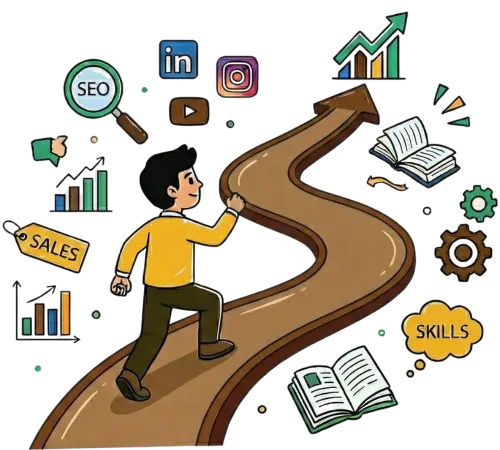
Yes – a BBA graduate is arguably the best-positioned degree of all for digital marketing, and you don’t need an MBA to earn well. In 2026, digital marketing rewards exactly what a BBA teaches – business strategy, marketing fundamentals, and management thinking – and pairs it with hands-on channel skills to land freshers ₹4.5-10.40 LPA roles, without the two extra years and heavy fees of an MBA.
Key Takeaways
- BBA is a direct-fit degree for digital marketing. Your grounding in marketing, management, and business strategy is exactly the foundation the field builds on.
- Freshers can earn ₹4.5-10.40 LPA with full-stack skills – matching or beating many post-MBA marketing starting salaries, reached faster and far cheaper.
- You don’t need an MBA to start. The gap between a BBA and a strong marketing job isn’t a second degree – it’s practical, job-ready channel skills plus a placement.
- BBA gives you the strategy; the tools are learnable in months. Marketing theory + hands-on Meta/Google Ads, SEO, analytics, and AI = a full-stack marketer.
- A full-stack, job-linked program is the fastest bridge. Learning the channels together – with real-brand practice and placements – beats stacking free certificates or defaulting into an MBA.
Can a BBA graduate get into digital marketing?
Yes – and it’s one of the most natural fits available. Digital marketing hires on demonstrated skill with ad platforms, analytics, and content, built on top of business and marketing understanding. A BBA graduate already has that understanding; what’s usually missing is the hands-on channel execution, which is learnable in months.
This is a smart, increasingly common move in 2026. Many BBA graduates assume the only next step is an MBA – but digital marketing lets you enter a high-demand field now, where “Digital Marketer” ranks among LinkedIn India’s most in-demand jobs and the digital ad market is pushing toward ₹50,000 crore, without spending two more years and lakhs in fees first.
Why BBA is the strongest-fit degree for digital marketing
Every degree teaches transferable skills – but BBA’s are the closest match of all, because it’s already a business-and-marketing degree. Here’s the mapping:
| What BBA teaches you | How it maps to digital marketing |
| Marketing fundamentals (4Ps, STP, branding) | The strategic backbone of every campaign – positioning, targeting, messaging |
| Consumer behaviour | Audience insight, creative angles, funnel and conversion thinking |
| Business & management strategy | Owning campaigns end-to-end, aligning marketing to business goals |
| Finance & budgeting basics | Managing ad spend, optimising CAC, ROAS, and marketing ROI |
| Communication & presentation | Content, social, client/stakeholder reporting |
| Market research & analytics exposure | GA4 dashboards, A/B testing, performance measurement |
The through-line: digital marketing at the ₹4.5-10.40 LPA level is about running full campaigns with strategic judgment across many tools – and a BBA already teaches the strategy half. Add the channel execution and you’re a full-stack marketer.
What digital marketing roles can a BBA graduate get?
A business-and-marketing foundation opens the whole field, with strategy- and management-facing roles especially within reach:
- Digital Marketing Executive – runs campaigns across channels tied to business goals; a broad, natural BBA fit.
- Performance Marketing Executive – paid campaigns on Meta and Google Ads, optimised for ROAS.
- Brand / Social Media Executive – positioning, content, and community, built on BBA branding fundamentals.
- Growth Marketer – cross-channel, experiment-driven campaigns.
- Marketing Analyst – GA4, dashboards, attribution, and reporting.
- Account / Client Servicing Executive (agency) – managing brand accounts; rewards BBA communication and management skills.
Digital marketing salary after BBA in 2026
Salary tracks skill depth, not just the degree. A realistic band for a BBA graduate on the full-stack path, set against the two default routes a BBA usually weighs:
| Experience | Digital Marketing CTC | Typical BBA default path |
| Fresher (0-1 yr), full-stack trained | ₹4.5-10.40 LPA | Generic BBA fresher role: ₹2.5-4 LPA · post-MBA marketing start (after 2 yrs + fees): ₹6-12 LPA |
| 3-5 years | ₹9-20 LPA | – |
| 8+ years (lead/manager) | ₹30+ LPA | – |
That middle column is the whole argument: a full-stack-trained BBA fresher at ₹4.5-10 LPA can match many post-MBA marketing starting salaries – without the two extra years and lakhs in fees. Industry practitioners note roughly 90% of digital marketing freshers stay stuck at ₹2-3 LPA and only about 1% reach ₹7+ LPA early; the ones who break out learned to run a full campaign and prove the return.
For a BBA grad the gap is specific: you already have the strategy half – the 4Ps, positioning, consumer behaviour. A ₹2-3 LPA marketer has theory but executes one tool on instructions. A ₹4.5-10.40 LPA marketer pairs that strategy with hands-on execution across 20+ tools and owns the outcome. You’re closer to the second than most degrees start.
Skills and tools a BBA graduate should learn
You already have the strategy half of the stack; the job is to add hands-on execution. For a BBA graduate:
Play to your BBA strengths (you have the theory – now apply it):
- Campaign strategy & brand – positioning, targeting, and messaging are your 4Ps and STP in action.
- Content & social – built on your branding and communication training.
- Marketing analytics – GA4 and reporting, extending your market-research and numbers exposure.
- Client/stakeholder management – agency account and reporting roles reward BBA communication skills.
Build your stretch areas (hands-on execution you haven’t done yet):
- Meta Ads & Google Ads – the paid-media core, run on real budgets (Search, Shopping, Display, YouTube).
- SEO – technical and content.
- E-commerce & marketplace marketing – D2C plus Amazon Ads.
- Programmatic – DV360 / CM360.
- AI & “vibe coding” – using AI to build simple automations and analyses, no technical background needed.
- LLM/GEO optimisation – getting content cited by ChatGPT, Gemini, and AI Overviews.
Free platform certifications – Google Skillshop, Meta Blueprint, HubSpot Academy – anchor the fundamentals, especially your stretch areas. They teach tools well but rarely teach the judgment to combine them, and they don’t get you hired on their own.
A note on AI: AI won’t take digital marketing jobs – it penalises the people who don’t adopt it. This suits a BBA grad well: strategy and judgment (your foundation) are the hard-to-automate parts, while AI now handles much of the execution – so your degree’s strengths matter more in an AI world, not less.
BBA + digital marketing vs an MBA
This is the decision most BBA graduates actually face. An honest comparison:
- MBA – strong for long-term leadership roles and networks, but it costs ₹2-20 L/yr plus two years of opportunity cost, and the payoff isn’t guaranteed. Many marketing roles it leads to are reachable sooner through skills.
- BBA + full-stack digital marketing – job-ready in months, far cheaper, and pays ₹4.5-10.40 LPA to freshers – often matching post-MBA marketing starting salaries. You keep the option to do an MBA later, with experience and savings behind you.
For most BBA grads whose goal is a well-paid marketing career soon, skills-plus-placement is the faster, lower-risk route. An MBA makes more sense once you know the domain and want to move into senior leadership. It’s not either/or forever – it’s about sequence.
Course vs self-learning: what actually gets you hired
You can self-learn the tools from YouTube and free certs – and with your marketing grounding you’ll understand the why faster than most. But knowing the theory and a few tools isn’t what stalls BBA grads. Employers hire proof of judgment and real outcomes, and self-learners rarely have real-brand work to show or a placement pipeline. That’s why so many BBA graduates with certificates still don’t get interview calls.
A structured, job-linked program closes the gap: it teaches the full stack with judgment rather than tool-by-tool, puts you on live real-brand projects, and ties itself to placements. That’s the leap from “I have a BBA and a few certs” to “I got hired in marketing.”
How Kraftshala fits in
Kraftshala’s Marketing Launchpad (MLP) is a job-linked, full-stack digital marketing program built for freshers and early-career switchers – a strong fit for BBA graduates who already have the business foundation and want the hands-on channel skills plus a placement.
- Outcomes: 3,300+ students placed; 94% placement rate; fresher CTCs of ₹4.5-10.40 LPA (highest ₹10.40 LPA); 800+ recruiting partners including Publicis Global Delivery (the #1 marketing talent provider globally), Nykaa, Mamaearth, Dentsu, Performics, Lenskart, Zomato, and Myntra.
- Real accountability: if a graduate is placed below ₹4.5 LPA, Kraftshala refunds 60% of the fee – the program has skin in the game.
- What you learn: the full stack above – Meta & Google Ads, SEO, GA4/GTM/Looker, programmatic (CM360), CRO, e-commerce, content & social, email automation, plus AI integrated across every module, vibe coding (~15 hrs), and LLM/GEO optimisation.
- Format: 6 months / 920+ hours full-time, with an 11-month weekend-led part-time option. Fee: ₹1,64,000 + 18% GST; EMI available.
For BBA graduates specifically weighing a marketing career, Kraftshala also runs MBA-alternative programs – including the PGP in AI-Led Sales, Marketing and Business (9 months, 100% placement rate, avg ₹10-10.6 LPA, highest ₹22 LPA) for those targeting higher-CTC sales and marketing leadership roles without a traditional MBA. Both run on “Real Play” – live practice on real brands rather than simulations.
How to start: a step-by-step roadmap
- Connect theory to channels first – map your BBA marketing fundamentals (STP, 4Ps, consumer behaviour) onto how digital channels actually drive revenue. This is your fastest ramp.
- Add hands-on paid media – Meta Ads, then Google Ads, on real budgets – the execution you haven’t done yet.
- Add SEO and analytics – GA4, GTM, technical and content SEO.
- Layer AI and automation – use AI across creative/analysis and build simple automations with vibe coding.
- Build a portfolio – run real or simulated campaigns; show strategy and results, not just theory.
- Get placed – target roles via a program pipeline or direct applications, treating each interview as a sales exercise (product = you).
Of all undergraduate degrees, BBA is the most natural fit for digital marketing – you already own the strategy half of the job. The missing piece is hands-on execution across the channels, and that’s learnable in months, not another two-year degree. A full-stack-trained BBA fresher at ₹4.5-10.40 LPA can match many post-MBA marketing starts without the cost or the wait, and can still pursue an MBA later, with experience and savings behind them. Treat the MBA as a sequencing question, not a default: get skilled, get placed, and let the degree you already have start paying off now.
Frequently Asked Questions
Can I do digital marketing after BBA?
Yes – it’s one of the most natural fits. BBA’s marketing and business foundation is exactly what digital marketing builds on; you just add hands-on channel skills.
Is digital marketing a good career for BBA graduates?
Yes. It pays freshers ₹4.5-10 LPA with full-stack skills, matches many post-MBA marketing starting salaries, and gets you earning in months rather than years.
What is the salary after BBA in digital marketing?
Full-stack-trained freshers typically earn ₹4.5-10 LPA, rising to ₹9-20 LPA at 3-5 years and ₹30+ LPA at senior levels. Theory-only or single-skill marketers tend to stay at ₹2-3 LPA.
Should I do an MBA or digital marketing after BBA?
If your goal is a well-paid marketing job soon, full-stack skills plus a placement are faster and far cheaper – often matching post-MBA marketing salaries. An MBA makes more sense later, for senior leadership. It’s about sequence, not either/or.
Do I need technical or coding skills for digital marketing?
No. BBA’s strategy and business strengths are the core fit; AI now handles much of the technical heavy lifting with the right training.
Which digital marketing role suits a BBA graduate best?
Digital marketing executive, performance marketing, brand/social, growth, and agency account roles – all lean on BBA’s marketing and management strengths.
How long does it take to become a digital marketer after BBA?
With a focused full-stack program like Marketing Launchpad, roughly 6 months to job-ready. Self-learning varies widely and often stalls without real-brand practice and a placement pipeline.
Will AI replace digital marketing jobs?
No. AI automates repetitive execution and creates demand for marketers who use it well. It penalises non-adopters, not skilled ones.



Nishtha Jain 

Head of Marketing, Kraftshala
Nishtha Jain is the Head of Marketing at Kraftshala, largest marketing jobs providing edtech platform in India. ... read more