



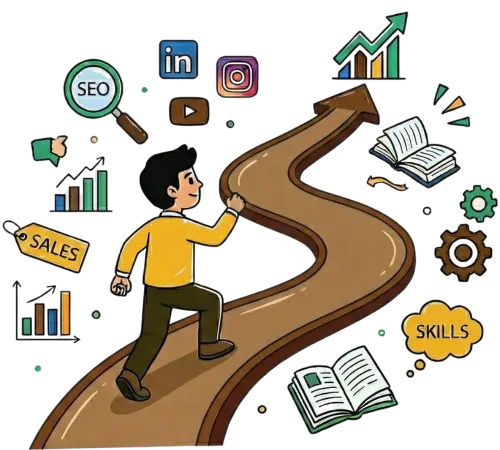
The honest answer: if you can break directly into B2B sales – especially software – start there, because it pays more, earlier, and has a far higher ceiling. But B2C is not the consolation prize. It’s the easier door to walk through, it builds raw selling muscle faster than anything else, and for a huge number of successful salespeople it was the on-ramp, not the destination. The right first move depends less on which is “better” and more on which one you can actually get into right now.
What’s the real difference between B2B and B2C sales?
B2C sales means selling to individual consumers – insurance policies, credit cards, FMCG products on a shop shelf, a gym membership. The deals are small, the cycle is short (often a single conversation), and success is a volume game: you talk to a lot of people, hear “no” constantly, and win on persistence and energy.
B2B sales means selling to other businesses – software, enterprise services, bulk supply. Deals are large, cycles run weeks or months, and you’re rarely selling to one person. You’re navigating a buying committee where the person with the pain, the person with the budget, and the person who signs are often three different people. Fahad Mistry, now a VP of Sales, teaches a seven-step B2B process for exactly this reason – from defining your ideal customer and mapping the buying committee, to a discovery call that’s 80% listening, to a pilot that expands into a full contract. That structure exists because a B2B deal is a project, not a pitch.
The simplest way to feel the difference: B2C tests whether you can win a conversation. B2B tests whether you can win a relationship.
Which one actually pays more?
B2B, and it isn’t close at the top end – but the reason matters more than the fact. It comes down to margins. A software company keeps 60-90 paise of every rupee as gross margin; an FMCG company keeps 30-50. When each new customer is almost pure profit, the business can afford to pay the person who closed them a commission that a low-margin consumer business simply cannot.
That margin structure is why the steepest pay curves in Indian sales live in B2B SaaS. Deepak Lamba, now CRO of CleverTap after building sales teams at Dell, HP, Oracle, Adobe and Wingify, points to people he hired at ₹3.5-6 LPA who crossed ₹50 LPA within three years. The standard B2B software path – starting as an SDR (Sales Development Rep) and moving up to Account Executive – can roughly triple your salary in three years. Kraftshala’s sales graduates, many going into B2B roles, come out at an average of ₹10.64 LPA, with a top offer of ₹22 LPA.
B2C sales can pay well too, but the ceiling is structurally lower for most roles, because the margin that funds your commission is thinner. Manav Paroothi frames the underlying rule as the “Proximity to Money” principle: money flows downstream to whoever is closest to bringing in revenue, and the higher the margin on that revenue, the more there is to share. B2B SaaS simply sits closer to a richer stream.
Which is easier to break into as a fresher?
B2C, by a wide margin – and this is the honest case for starting there. Consumer sales roles hire in volume, ask for little prior experience, and put you in front of customers on day one. Fahad Mistry’s own start was in insurance at Religare, where he was one of just 800 selected and went on to sell ₹4.55 crore in policies. That’s a classic high-volume B2C crucible: it throws you into rejection immediately and forces you to learn how to sell under pressure, fast.
Consumer selling doesn’t only mean insurance. Classic FMCG field sales – the ground-level distribution work of getting products onto shelves across a territory – is the same school of hard knocks. Kraftshala’s co-founder Eshu Sharma did it for Hindustan Unilever across Bhavnagar, Surendranagar and Rajkot in Gujarat; Pramod Srivastava started as a Parle sales officer before pivoting into growth marketing at Swiggy. Both learned the trade on their feet, in the field, talking to shopkeepers – the kind of grounding that makes every later sales role easier.
B2B, especially enterprise software, has historically been harder to enter cold. Companies wanted proven closers because the deals are too expensive to hand to someone still learning. That’s changing – but it’s changing for candidates who can prove capability, not just claim it. Anjana Jose, a BA Psychology graduate, and Deeksha, a BCom graduate with a two-year resume gap, both joined Kraftshala’s PGP in AI-led Sales, Marketing & Business, and walked directly into top B2B SaaS roles (Rippling and BrowserStack) with no prior sales jobs – because they arrived with a live project (at Kraftshala School of Business (formerly Kraftshala)) that demonstrated they could do the work. If you can manufacture that kind of proof, B2B is now enterable directly. If you can’t yet, B2C is the faster way to start earning and learning.
What does each one actually teach you?
B2C teaches you the fundamentals that never stop mattering: how to open a cold conversation, how to handle rejection without deflating, how to read a person quickly, and how to keep going when the last ten answers were “no.” These are muscles, and volume builds them faster than anything. A year of high-intensity consumer selling can make you fearless in a way a slower B2B role won’t.
B2B teaches you a different, more strategic layer: how to qualify a serious opportunity from a time-waster, how to run a long process without losing momentum, and how to sell to a room rather than a person. Deepak Lamba’s BAND method captures the core discipline – before you invest in any deal, you check whether the prospect has Budget, whether you’re talking to someone with Authority, whether the Need is real and urgent, and what the Timeframe is. Manav’s GTM thinking adds the commercial layer: positioning a product by the “cost of not using it” rather than its features. B2C makes you a strong seller; B2B makes you a strategic one. The best salespeople have both, which is exactly why the B2C-to-B2B path is so common.
Can you switch from B2C to B2B later?
Yes – it’s one of the most well-trodden routes in sales, and it’s a documented question people ask constantly: they have a couple of years of B2C experience and want to know if they can cross over. You can. The resilience and closing instinct you build in consumer sales transfer directly; what you add is the strategic layer – qualification, buying committees, longer cycles.
The honest caveat is that the switch isn’t automatic. Employers hiring for B2B want evidence you understand how the B2B game is different, not just that you’ve “done sales.” That’s the gap structured programs are built to close: they take someone with raw selling experience (or none at all) and add the B2B frameworks, the SaaS commercial logic, and a live project that proves the transition on paper. Fahad Mistry’s own line makes the point – what took him 14 years of wandering between industries to figure out, a focused seven-month program can now compress into a single deliberate move.
So which should you start in?
Start in B2B if you can get in – the ceiling is higher, the pay compounds faster, and the earlier you’re close to high-margin revenue, the sooner that math works for you. Thanks to proof-based hiring, that door is now open to people from non-sales backgrounds in a way it wasn’t a few years ago.
But if the B2B door isn’t open to you yet, do not wait around for it. Start in B2C, build the raw selling muscle that only volume can give you, and use it as a springboard – deliberately, with a plan to add the B2B strategic layer within a year or two. The worst move isn’t starting in B2C; it’s staying in a low-ceiling consumer role for five years by default and never making the jump.
The deeper truth underneath both paths is the one that should shape your decision: sales rewards demonstrated ability over pedigree faster than almost any career in India. Whichever side you start on, the people who win are the ones who can prove they bring in revenue. Pick the entry point you can actually reach – then get close to the money as fast as you can.
Want to enter B2B sales directly – or make the jump from B2C?
Kraftshala’s PGP in AI-led Sales, Marketing and Business is a 9-month, fully live program that adds exactly the layer B2B employers look for: qualification frameworks like BAND, the full B2B sales process, SaaS commercial logic, and a live project that proves you can do the job on paper. Learn from practitioners like Deepak Lamba (CRO, CleverTap) and Fahad Mistry (VP Sales), graduate at an average of ₹10.64 LPA with top offers up to ₹22 LPA – and if your salary is below ₹7.5 LPA, get 60% of your fees back.



Nishtha Jain 

Head of Marketing, Kraftshala
Nishtha Jain is the Head of Marketing at Kraftshala, largest marketing jobs providing edtech platform in India. ... read more